
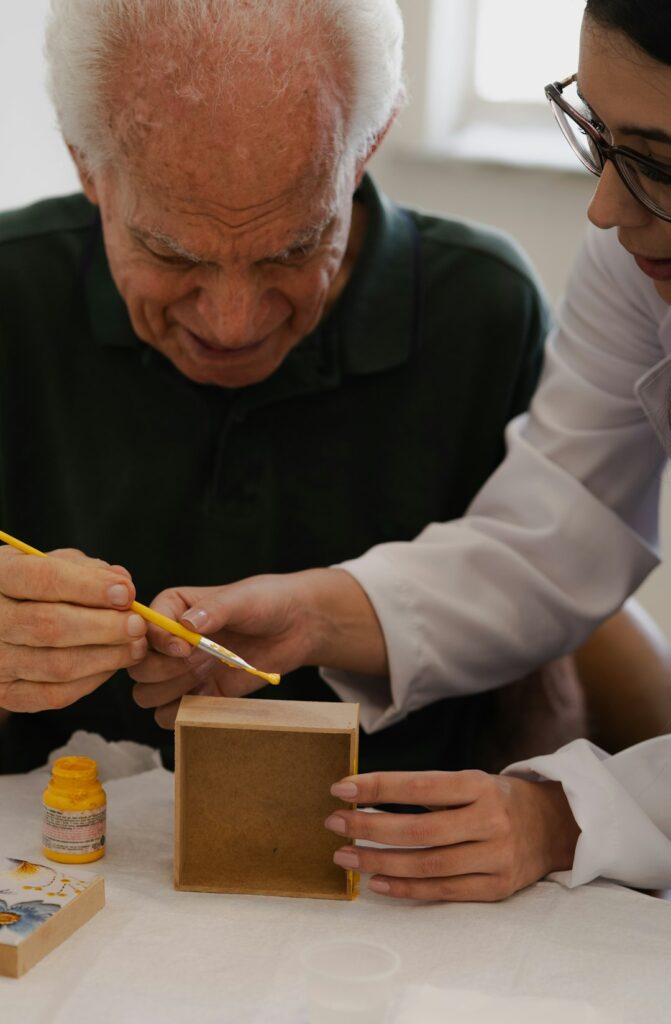
Creativity remains meaningful at every age. In assisted living, creative activities can support self-expression, social connection, memory, movement, and a stronger sense of personal identity. These benefits do not depend on artistic experience or producing a polished finished project.
Why does creativity matter for older adults?
Creative activity gives residents a way to make choices, communicate feelings, and stay connected to familiar interests. Painting, music, storytelling, gardening, cooking, photography, crafts, and decorating can all provide meaningful engagement.
Creativity may also support daily well-being by:
- Encouraging conversation and shared memories
- Offering a sense of purpose and accomplishment
- Supporting hand strength, coordination, and dexterity
- Providing structured activity without feeling like a test
- Reducing boredom and social isolation
- Creating opportunities for residents with different abilities to participate together
A person does not need to identify as an artist to benefit. Someone who once enjoyed sewing may prefer sorting fabrics, choosing colors, or listening to music from a particular period. A former gardener may enjoy arranging flowers, planting herbs in containers, or discussing seasonal changes.
How can assisted living communities make creative activities more inclusive?
The most inclusive programs offer several ways to participate. Residents should be able to create, observe, discuss, organize materials, or simply enjoy the atmosphere without pressure to complete a project.
Activities can be adapted by changing:
- The size and weight of tools
- The amount of written instruction
- The length of the session
- The number of steps in a project
- The type of sensory input, such as sound, texture, scent, or light
- The location, including a quiet room for residents who become overstimulated
For residents with arthritis, large-handled brushes, foam grips, pre-cut materials, and lightweight containers may make participation easier. A resident with limited vision may enjoy textured collages, music, clay, scented herbs, or verbal storytelling. A person living with memory loss may respond well to familiar songs, repetitive movements, and activities connected to earlier life experiences.
Adaptation should preserve dignity. Adults generally respond better when materials look purposeful and attractive rather than childish. The goal is not to simplify a person’s identity, but to remove unnecessary barriers.
What creative activities work well in assisted living?
The most effective activities are usually flexible, familiar, and easy to enter at different skill levels. A resident may participate for ten minutes or remain involved for an hour.
Useful options include:
Music and singing
Music can encourage participation even when speech, memory, or mobility has changed. Residents might listen to familiar recordings, sing along, play simple percussion instruments, or share stories about dances, concerts, or songs connected to family life.
Music sessions can also be arranged around seasons, personal milestones, or cultural traditions. Volume should be comfortable, with quieter alternatives available for residents who are sensitive to noise.
Visual arts and crafts
Drawing, watercolor, collage, knitting, weaving, paper crafts, and simple sculpture offer many levels of difficulty. Projects should allow personal choice rather than requiring everyone to produce the same result.
A shared mural or seasonal display can help residents contribute individually to something visible in the community. However, participation should remain voluntary, and residents should not be judged by neatness or artistic quality.
Storytelling and life review
Writing short memories, recording oral histories, creating family recipe cards, or assembling a “favorite things” booklet can help preserve personal experiences. Prompts might include:
- A job or role that shaped your life
- A favorite holiday tradition
- Music remembered from adolescence
- A place that felt like home
- A meal often prepared for family
- Advice once received from a parent or mentor
Staff should avoid treating these conversations as an examination. The value comes from listening and allowing residents to decide what they want to share.
Nature-based creativity

Container gardening, flower arranging, leaf rubbing, seed sorting, and herb-related activities connect residents with the natural world. In Wyomissing, seasonal changes can provide familiar themes for indoor and outdoor projects, particularly during cold weather when outdoor time may be limited.
Indoor windowsill gardens and tabletop arrangements can offer nature-based activity throughout the year. Care is needed with allergies, plant toxicity, spills, and residents who may have difficulty distinguishing edible plants from ornamental ones.
Cooking and food traditions
Food-related creativity can include decorating, recipe discussion, assembling simple ingredients, or creating a community cookbook. Activities should account for swallowing needs, allergies, diabetes-related dietary instructions, and food-safety requirements.
Residents do not need to handle hot surfaces or sharp tools to contribute. Measuring, choosing seasonings, folding napkins, describing family traditions, or sharing memories may be equally meaningful.
How should activities be adapted for residents with dementia?
Creative activity for someone with dementia should focus on enjoyment and participation rather than accuracy. Correcting mistakes, asking too many questions, or insisting on a particular outcome can create frustration.
Helpful approaches include:
- Demonstrating one step at a time
- Using familiar materials and recognizable themes
- Offering two simple choices instead of many options
- Allowing extra time for responses
- Praising effort without making exaggerated claims
- Redirecting calmly if the resident becomes confused
- Stopping when signs of fatigue, distress, or overstimulation appear
A resident may repeat the same action, change the subject, or create something abstract. That does not mean the activity failed. Engagement may be shown through attention, facial expression, relaxed movement, humming, conversation, or willingness to remain near others.
How can family members support creativity?
Family members can learn about a resident’s past interests and share practical details with activity staff or caregivers. Useful information may include favorite music, former hobbies, meaningful colors, cultural traditions, professional skills, and activities the person disliked.
Families can also bring safe, familiar materials such as photographs, fabric samples, large-print recipe cards, or copies of personal artwork. Items should be labeled and easy to store. Valuable originals, fragile objects, and materials with small parts may not be suitable for shared activity areas.
Visits can include creative participation without turning the visit into a formal project. Looking through photographs, singing familiar songs, arranging flowers, or discussing a favorite hobby may be more comfortable than starting a new craft.
What safety concerns should be considered?
Creative programs should account for fall risks, choking hazards, allergies, infection control, sharp tools, hot liquids, electrical cords, and toxic materials. Paints, adhesives, plants, and craft supplies need appropriate labeling and storage.
Seasonal conditions also matter. During hot or humid weather, indoor rooms may be more comfortable for longer activities. During winter, wet floors from snow or tracked-in moisture can create hazards near entrances and activity spaces. Good lighting, stable seating, clear walkways, and easy access to restrooms help residents participate safely.
Safety planning should not eliminate meaningful choice. Instead, activities can be redesigned so residents retain control while avoidable risks are reduced.
How can success be measured?
Success is not necessarily a finished object or a large attendance number. A successful activity may be one in which a resident makes a choice, talks with another person, recalls a meaningful experience, or enjoys a few calm minutes of concentration.
Observing preferences over time can help identify what works. Staff and families may notice that a resident participates more readily in the morning, prefers small groups, enjoys familiar music, or needs frequent breaks. Those observations can guide future activities without labeling the resident by a single diagnosis or ability level.
Creative life in assisted living is strongest when it reflects the person, not merely the activity calendar. Giving residents real choices, familiar themes, adaptable materials, and time to participate at their own pace allows creativity to remain part of everyday life.
